
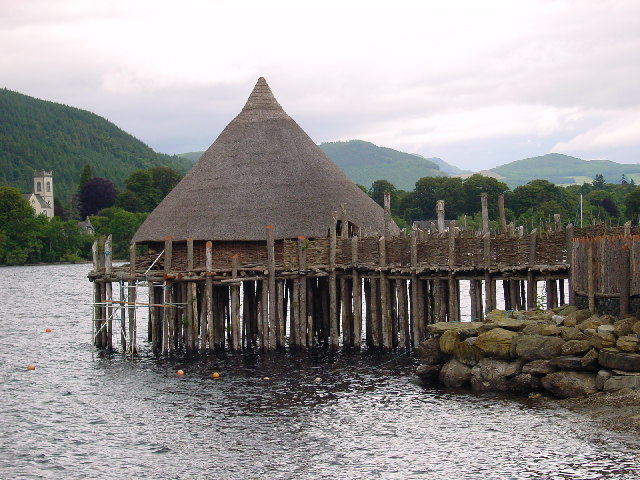
A reconstructed crannog on Loch Tay. Photo taken by Christine Westerback on July 25, 2002.

An ancient crannog on Loughbrickland lake, Cownty down, Northern Ireland.
Crannogs (I am not sure of the spelling of the plural) are artificial islands that were built all over Scotland and Northern Ireland, with at least one in Wales. This is a word that actually crosses languages very well. It is easy to recognize in Scots-Gaelic and Gaelic both, and English had no choice but to pick up the word because, well, there’s nothing like in the English world. This is a good time to point out that the people of North Ireland and Scotland share a great deal of culture.
My daughter’s history book tells us about Nebuchadnezzar, the King of Babylon about 500 b.c.e. (before common era). To make his city the most fortified in all of what is now the Middle East, he built a moat around the city walls and actually redirected the Euphrates river to fill it. Doubtless any Scot passing through the area (no, I have no clue why he would be there) would ask, “Have ye nothing better to do with your time?”
Scots and other Gaelic people took a very different route. Rather than digging a moat, they built an island in a loch. They would pick a spot in the loch not far from the shore and very shallow. They would throw rocks into the loch to build a dry path. When they were satisfactorily far enough out, they would throw even more rocks to make an island. Then, depending on the area and the availability of wood, they would either build a dwelling like the one in the first picture or just build a stone house. No muss, no fuss.
The oldest crannogs appear to be about 5000 years old. Yes ladies and gentlemen, that’s all the way back to the old kingdom of Egypt, about the time, according to some historians, that Abraham appeared on the scene. Entire empires have risen and fallen, trying to build great monuments so that the world would remember them. Meanwhile the Scots were snug in houses that, with the quick destruction of the bridge, were just not worth wading out and invading.
Does building a crannog sound like a lot of work? Well, yes, but remember three things. One, these were often multifamily dwellings. Many hands make light work. Two, the growing season is very short in Scotland. If everyone spent a couple hours pitching rocks in the loch every day of winter, the island would appear more quickly than you’d think.
Three, Scots don’t expect things to happen quickly. I can easily imagine kids measuring their growth by the size of the rocks they could throw each year. Can you imagine the toddlers? “Sure, throw all the rocks you want.” The focus of a Scot’s life is at least as much on their family as it is on themselves. What does it matter if you don’t see something finished? Your family will be safe for generations, and you’ll be part of them for making it happen.
The second picture is an example of what happened to crannogs after the family moved out. As you can see, it is covered with vegetation. Even animals don’t bother to invade it. Crannogs, and the stone family houses built on them, were still quite active into the 17th and even 18th centuries. Archeological expeditions, even ones underwater, are learning more about them all of the time, and we await some carbon dating to prove the 5,000 year number (present ones go back only 2,500).


 Loving Leed: An American learning Scots