Loch

Loch photo

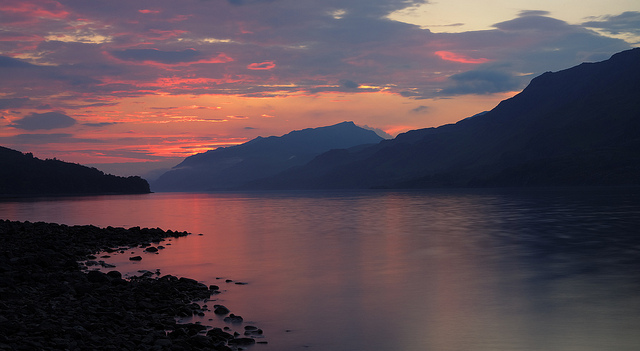
Loch is the Scots word for lake or pond “applied to all natural lakes in Scotland, except the Lake of Menteith Perthshire” (The Essential Scots Dictionary, p. 109). It’s originally a Scots-Gaelic word, but has been picked up by Scots as well. Two related words are sea-loch , which is a branch of the sea that invades the land, and lochan, which means little-loch, perhaps pond-size.

Geologists picked up the word Loch to describe a phenomenon that is common in Scotland but unusual elsewhere. Some of the lochs are extremely deep and actually connect to underground sea-caves. This is the common explanation for why the loch-ness monster only rarely appears; it’s out at sea most of the time. Lochs can be fresh water, saltwater, or brackish (diluted salt water, like the Chesapeake Bay). Lochs can also be very shallow. With mist and fish and towns nearby, lochs are part of Scotland like Main Street is to small-town America.

Loch Ness has an important place in my clan, the Urquharts. It sits very near Urquhart Valley, the ancestral home of my clan. There is a splendid caste with a wonderful lawn where the family reunions are often held. Now, the castle actually has nothing to do with the family. It was built after the family had moved and built it’s home castle elsewhere. Urquhart Castle on Loch Ness was named for the valley instead.

Here’s the trick. The Urquhart’s destroyed their castle (literally blew it up) to keep it from falling into enemy hands during the Jacobite rebellion (more on all of that later). It now stands as a beautiful set of ruins on the country’s “places to film” list.

Now really, if you were to save up for years to travel thousands of miles to meet your clan, would you rather go to a tourist town with lots of nice hotels thanks to a monster’s myth, or camp out in the rough? Yep, I vote for the hotels, too. My version of camping generally involves some source of hot and cold running water anyway. Thus Loch Ness remains near and dear to our heart, for historic and practical reasons.

photo credit: Viktor Simonic via photopin cc

Posted in Uncategorized | Leave a comment

Wir ain Leed? (What is Scots?)

Scotland topographic map-en
Scotland is a land of three languages, all of which aren’t indigenous to the area. Pictish is the oldest known language of the area, though little of it is left. If you look at the map, you can see that there are ridges of mountains that run northeast to southwest. The British isles have lots of hills and moors and mountain passes. Historically people lived in pockets rather than even distributions. So languages have been very local things: Scots, English, Welsh, Scots-Gaelic. Add to this the varied accents from cockney to Cornish, mixed in the fact that the Church spoke Latin and the Aristocracy wanted to speak French, and you have a language mud beyond American comprehension.

English and Scots both come from the common language form the Angles. This common ancestor crept up the western shore to the lowlands and eventually made all the way up to the Island Shetland. This is part of the reason Scots has so many names.

The two share many words, especially critical words like “the”, leading linguists to question whether Scots is a separate language. Polls have shown that people who don’t speak Scots generally consider it another language, while people who do speak Scots often consider it a dialect. Personally I think there’s a coded insult in that. For centuries people were told that Scots is an inferior form of English. By telling us that it’s a dialect, it seems to me that Scotsmen are saying, “What, are you really so dumb that you can’t understand our inferior speech?”. The European Union classifies Scots as a minority language, and the Scottish government recognized it officially, so the argument has ended in the public realm. Switching between English and Scots is like switching between Spanish and Portugal; just adjusting the accent helps a lot, but you will eventually get lost.

Speakers of an old form of Gaelic settled from the northwest corner on the islands and northern edge. This mixed with the local vocabulary to create Scots-Gaelic. This language is older, and Gaelic names of places remain some Scots-speaking areas. Scots-Gaelic is not interchangeable with Irish Gaelic. The have the same common ancestor. The comparison there is like Italian and French. Knowing Latin helps, but it’s an uphill climb.

How do you tell the difference? If you can catch a word hear and there, it’s Scots. Gaelic has all of the right syllables (plus a few extra), but none of the words are the same.

For more information check out this webpage Wir ain Leed.

Posted in Uncategorized | Leave a comment

Begin the vaige!

small_458386812

Weird last word, hmm? Go back and sound it out one letter at a time, and you might find it familiar. The word is voyage in the language of Scots, perhaps English’s closest relatives as languages go. (Do not say that to a Scotsman; you might not get a good response).

Scots, also known as Doric, Leed, and Shetland, is a language that rings in the back of my head. My family has been fans of all things Scottish for a long time. But it’s also because I grew up in the Northeastern United States, literally across the river from Canada, that Scots isn’t far from my head. Bonny, loch, glen, lassie, lad, wee, and countless other scots words are a standard part of my American vocabulary. We learned “My Bonny lies over the ocean” right along with “Erie Cannal” and “The Star Spangled Banner”.

After months of banging my head on the table and raking the internet (raking is Scots for searching) while listening to songs and translating jokes, I’ve decided to embark on a journey to learn Scots. It’s going to be historical, cultural, and just plain fun. I promise songs, jokes (as soon as I understand them), and the history and trivia of Scotland as we go. Will you join me?

photo credit: Vicki & Chuck Rogers via photopin cc

Posted in Uncategorized | Leave a comment